AI tools are no longer a novelty in content marketing. They are part of how we plan, draft, and ship at speed. I lean on them weekly because the throughput is hard to ignore.
The friction shows up when copy still reads like a machine wrote it. Search engines and readers both reward writing that feels authored, specific, and uneven in the right ways. My goal is never a perfect detector score for its own sake. It is prose that passes the human sniff test.
Below, we walk through ten techniques I use to make AI-assisted drafts read like something a person shaped on purpose, with structure edits and voice fixes you can repeat each week.
What is AI detection?
AI detection is the practice of using software to decide whether text was produced by a human or by a model, usually by comparing sentence rhythms, word predictability, and repeating structural habits against patterns typical of machine output.
For digital publishers, SEO teams, and content marketers, that label matters on pitches, compliance screens, and editorial standards, especially when buyers want proof of human workmanship. We see it in RFPs and workflow docs more often than we did two years ago.
It also helps when you outsource. I use quick scans to confirm a freelancer or agency did not paste an undisclosed first pass straight from a chat interface.
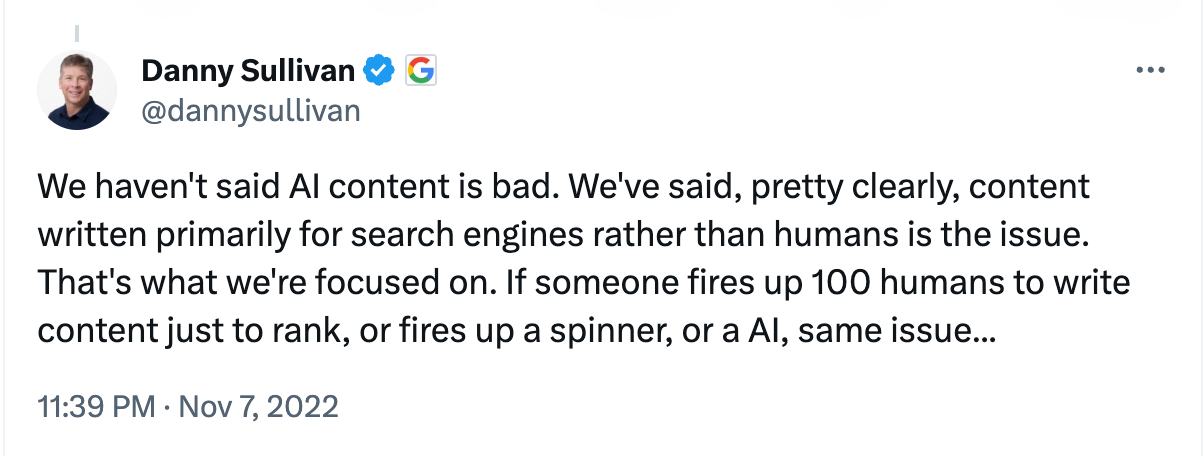
Ranking is a separate question. If your only concern is search performance, chasing detector percentages is not the homework Google assigns. Google has been clear that it cares whether the page is helpful and substantive, not which tool typed the first draft. I still ship AI-assisted pages when the substance is strong; the detector readout is not the final grade.
The screenshot that follows is Google's search liaison spelling out the same point.
How AI detectors actually work: perplexity, burstiness, and pattern recognition
AI detectors don't read your content the way a human editor would. Instead, they run statistical analyses on your text, measuring two primary metrics: perplexity and burstiness.
Perplexity measures how predictable your word choices are. When you write naturally, you make surprising choices — an unusual metaphor, a less common synonym, a phrase structured in an unexpected way. AI models, by contrast, are trained to predict the most likely next word. This makes AI-generated text statistically "low perplexity." The lower the perplexity score, the more likely a detector will flag the content as AI-written.
Burstiness measures the variation in your sentence lengths and structures. Human writers naturally produce "bursty" text — a long, complex sentence followed by a short punchy one, then a mid-length sentence with a parenthetical aside. AI tends to produce sentences of more uniform length and complexity. Low burstiness is a strong signal that text was machine-generated.
Beyond these two core metrics, modern detectors also use pattern recognition to identify stylistic fingerprints common to specific AI models. These include overused transitional phrases, consistent paragraph structures, and a tendency toward formal, hedging language.
Understanding these three mechanisms is essential because every technique in this guide works by disrupting one or more of them.
When I recommend varying your sentence structure, that directly increases burstiness. When I suggest replacing AI tell-words, that raises perplexity. The most effective approach combines multiple techniques to address all three detection vectors at once.
What are AI detection tools?
AI detection tools are specialized software designed to analyze text and determine whether it was written by a human or generated by AI. They use machine learning algorithms and natural language processing (NLP) to evaluate perplexity, burstiness, and stylistic patterns in your content.
The accuracy of these tools varies significantly. Not all detectors are created equal, and false positive rates — where human-written content is incorrectly flagged as AI — remain a real concern.
Here are the leading AI detection tools and their 2026 accuracy data:
- Surfer AI Detector: Surfer has been trained on a large collection of articles from before the AI era became mainstream, giving it a reliable baseline for distinguishing human-written from AI-generated content. Try it free.
- Originality.ai: Purpose-built for AI detection with a 4.0% false positive rate. Widely used by content agencies and publishers to audit content at scale.
- GPTZero: One of the most well-known detectors with an 8.4% false positive rate. Popular in academic and publishing contexts with a strong free tier.
- Grammarly: Ranked #1 by the RAID (Robust AI Detection) benchmark. Grammarly now includes a dedicated AI detector and an Authorship tracking feature that monitors writing in real-time to verify human involvement.
- Turnitin: The academic standard for plagiarism and AI detection. Its August 2025 update now detects text modified by AI humanizer tools, not just raw AI output — a major development for academic integrity.
- Copyleaks: Enterprise-focused with LMS integrations and strong performance on multi-language content detection.
- ZeroGPT: A free option, though its 12.0% false positive rate is higher than premium alternatives. Useful for quick checks but not reliable as a sole verification tool.
Important caveat: a 2026 study found a 61.3% average false positive rate on essays written by non-native English speakers. If your content is written by international writers, take detector scores with a grain of salt.
Can AI detectors identify AI-generated content?
AI content detectors are not 100% accurate and can produce false positives. Since detection tools rely on statistical patterns — primarily perplexity and burstiness scores — they can incorrectly flag human-written content that happens to follow similar patterns.
As our analysis shows, AI content detectors are not always reliable.
2026 benchmarks show false positive rates ranging from 1.6% to 12% across leading tools. These tools can mistakenly classify human-written content as AI-generated due to several factors:
- Predictable writing style: If you naturally write in clear, structured prose with common transitions, your text may score as low perplexity — the same metric that flags AI content.
- Repetitive phrases or ideas: Using similar phrases multiple times mimics the patterns detectors associate with AI. This remains one of the most common reasons for false AI detection.
- Non-native English writing: Studies show a 61.3% average false positive rate on essays written by non-native English speakers. Formal, textbook-style English closely resembles AI output patterns.
- Unusual grammar or syntax: Unconventional grammar can be misinterpreted as AI-generated content, especially by detectors trained on specific writing styles.
- Limited or biased training data: Some detectors are trained on narrow datasets, making them less accurate for specialized topics or niche writing styles.
- Evolving AI models: As AI writing tools improve, the gap between human and AI text narrows, making accurate detection increasingly difficult.
AI detection tools are constantly adapting, but no detector should be treated as infallible. I don't recommend relying solely on any single AI content detector to make definitive judgments about authorship.
It's worth addressing a common misconception about watermarking. OpenAI built watermarking technology capable of detecting AI-generated text with 99.9% accuracy, but in August 2024 they explicitly chose not to release it. The reasons: roughly 30% of users said they'd reduce ChatGPT usage, there's a significant false-positive risk for non-native English speakers, and watermarks can be circumvented through simple editing. OpenAI continues exploring alternative authentication methods, but text watermarking remains unreleased.
Meanwhile, Turnitin rolled out a significant update in August 2025 that specifically targets text modified by AI humanizer tools. The system now uses color-coded highlights — including cyan flags for content it suspects has been processed through a bypasser tool. This is a major development for anyone in academic settings.
If you want to generate content that avoids detection by search engines and AI content detectors, you can use Surfer's AI Humanizer. For content marketing purposes, your article will be recognized as human-written text. If you're in an academic setting, however, be aware that Turnitin's latest models are specifically trained to detect humanizer-modified content.
10 ways to avoid AI content detection
Now that you understand what AI detectors measure — perplexity, burstiness, and pattern recognition — you can tackle detection strategically rather than through guesswork.
Each of the 10 techniques below works because it disrupts one or more of these detection signals. I'd suggest combining multiple techniques for the most effective pass rate, since addressing all three vectors at once produces the best results.
Follow these 10 tips to avoid AI content detection in your writing.
1. Rephrase sentence structure and format
The quickest way to elude AI content detection is by rewriting and shuffling your sentences.
This involves modifying the sequence of words and phrases within a sentence, which can throw off detection algorithms that depend on grammatical patterns and combinations of words.
AI content detectors can find recurring patterns in your sentence phrasing.
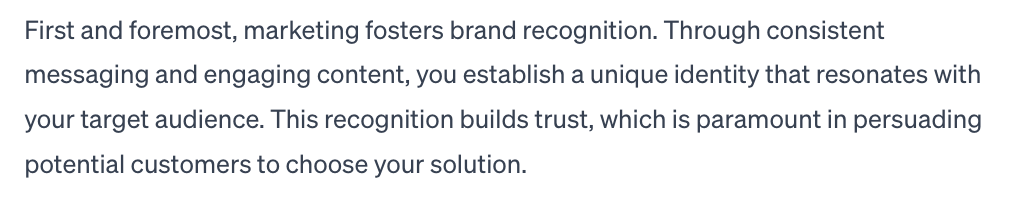
ChatGPT has a fondness for overusing terms that are now characteristic of its writing.
Here's an example.
Combining sentences can create a more complex sentence structure that becomes harder for AI to detect.
For instance, "The sun rose. It was a beautiful morning." can be combined to form "As the sun rose, it revealed a beautiful morning."
On the reverse side, breaking long sentences into shorter ones can make your content appear more human-like. This kind of variation directly increases your burstiness score — one of the two primary metrics detectors measure.
Let's take a look at an example of word substitution for ChatGPT content.
Here's a paragraph of ChatGPT's answer to "how to become a good marketer?"

Here's how we could rephrase it while maintaining its original meaning.
To become a good marketer for SaaS companies or marketing agencies, you need to do a few things. First, invest in ongoing learning to keep up with industry trends, SEO algorithms, and new marketing technologies. Second, you should really know your target audience, including their wants and needs.
Adopt decisions based on data by using analytics to track and improve campaigns. Encourage creativity and new ideas to make material that people want to read.
This is a simple way to keep the original meaning of your content while making sure AI systems do not detect AI-generated text.
Surfer's free paraphrasing tool can enhance your writing by improving readability and flow.
It allows you to rephrase paragraphs and sentences, ensuring they are clear, engaging, and professional without changing the original message.
2. Spot and replace overused AI words
One of the most reliable ways to avoid AI detection is learning to recognize the specific words and phrases that AI models overuse. These "AI tell-words" are so predictable that they lower your text's perplexity score — which is exactly what detectors look for.
Research shows that simply swapping in synonyms doesn't work. Vocabulary changes alone don't alter the underlying statistical behavior that detectors measure. Instead, you need to identify and eliminate the specific words that scream "AI wrote this."
Here's a practical checklist of the most common AI tell-words to watch for:
- Filler transitions: moreover, furthermore, additionally, consequently, thus
- Inflated verbs: delve, elevate, leverage, utilize, facilitate, streamline, foster, harness
- Dramatic nouns: tapestry, landscape, realm, journey, beacon, cornerstone
- Hedging phrases: "it's worth noting," "in the realm of," "it's important to understand," "one might argue"
- Overly polished openers: "In today's digital landscape," "In an era of," "When it comes to"
These words and phrases flag detectors because AI models are trained to predict the most likely next token. When ChatGPT reaches for "delve" instead of "dig into" or "explore," it's choosing the statistically safest option — and that's precisely what lowers perplexity.
The fix isn't to swap "delve" for another fancy word. It's to write the way you'd actually speak. Say "dig into" or "look at" or "break down."
It's so common that there's a whole Reddit thread dedicated to cataloging overused ChatGPT terms. Use it as a reference when reviewing your AI-generated drafts.
When you edit AI content, read through it specifically looking for these tell-words. Replace them with simpler, more natural alternatives that match how you'd actually explain the concept to a colleague.
3. Use an AI text humanizer
An AI text humanizer tweaks AI-generated content to mimic human writing, obscuring its artificial origins.
A text humanizer works by adjusting patterns typical of AI, so the content resonates more authentically with the audience.
An AI humanizer scans for commonly used AI phrases, eliminates the passive voice, and restructures sentences to give your content a more natural, human-like quality.
Surfer's free AI Humanizer tool can help you rewrite AI-generated content into humanized text.
This means you can use any AI writer, including ChatGPT, to create humanized AI content.
Using it is pretty simple:
- Head to Surfer's AI content humanizer tool
- Enter your content
Surfer will check your content to detect if it was written by an AI content generator and tell you the probability that it is AI-written.
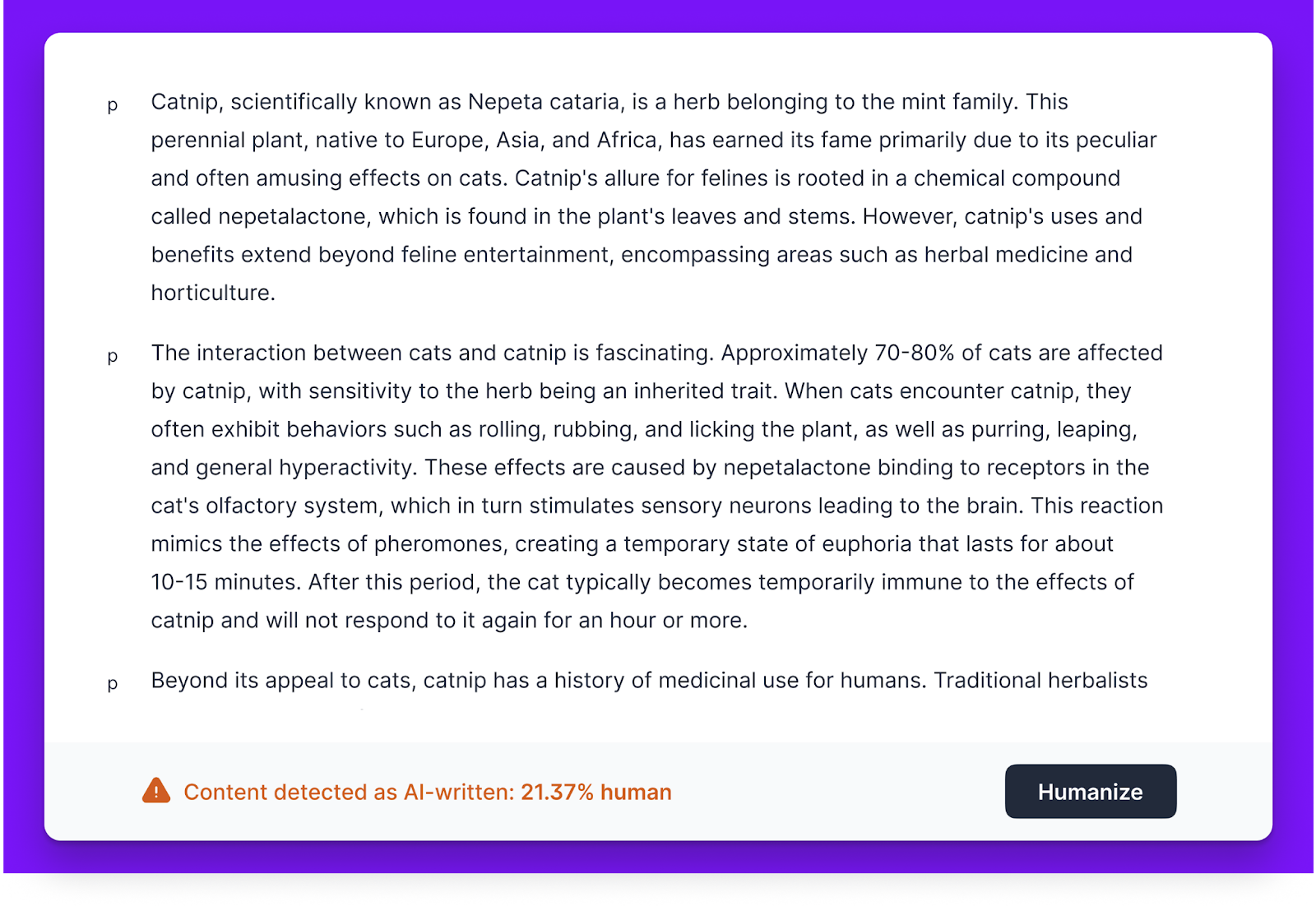
For example, 93% human means that there is a 93% likelihood that your content was written by a human writer.
Similarly, 7% human means there is only a 7% chance of your content being written by a real person.
You can then choose to humanize AI content into natural sounding text that appears to be written by a human.
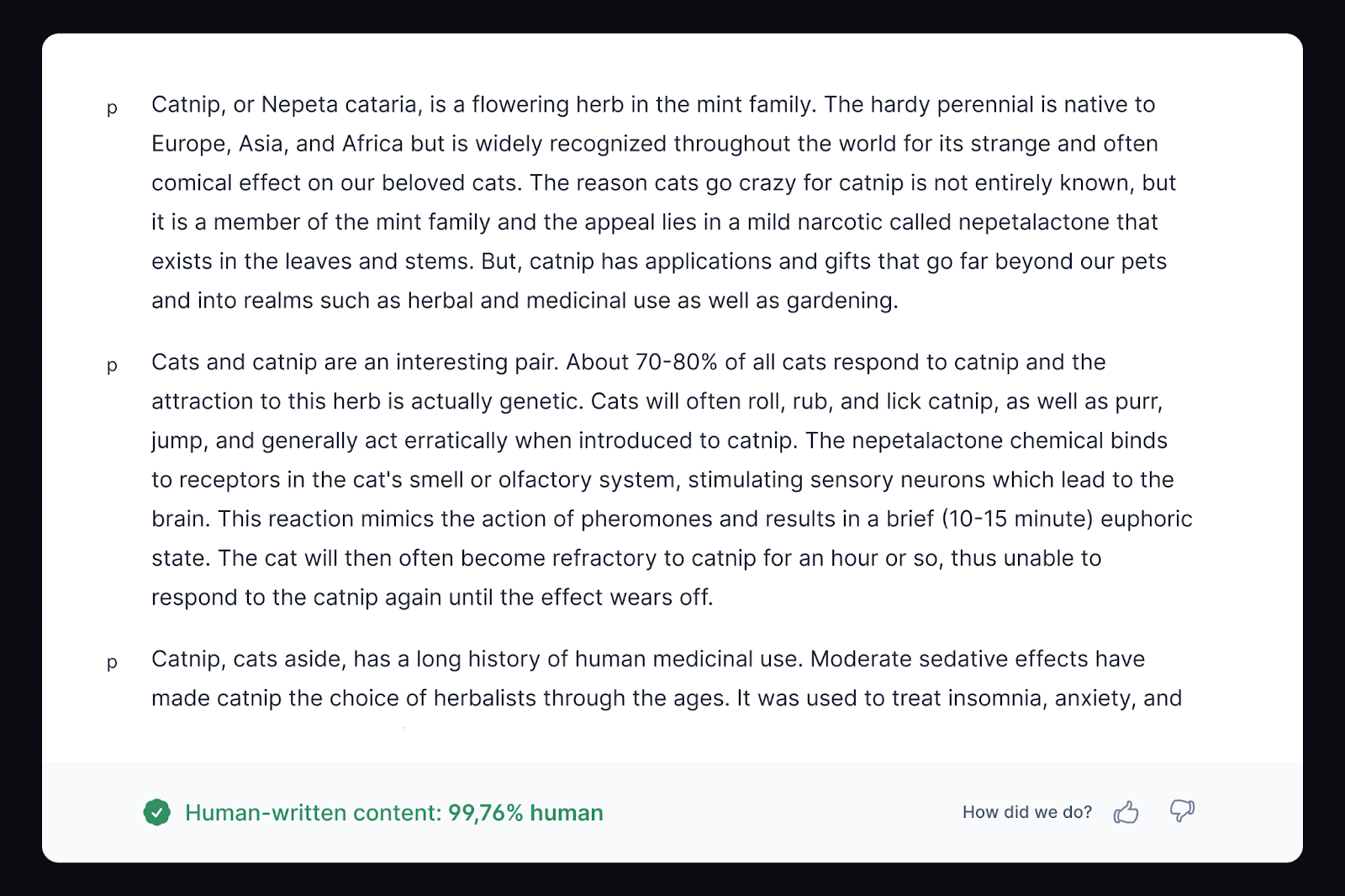
Rewriting AI content with Surfer's Humanizer can help you pass AI content detection tools and search engines.
One important caveat for academic users: Turnitin's August 2025 update now specifically detects text that has been processed through AI humanizer tools. The system uses color-coded highlights to flag content it suspects has been run through a bypasser. If you're in an academic setting, humanizer tools may not protect you from detection.
For content marketers and publishers, humanizers remain a powerful tool in your workflow — especially when combined with the manual editing techniques in this guide.
4. Avoid repetitive keywords and phrases
AI detection algorithms use machine learning and natural language processing to identify repetitive or formulaic language that may indicate AI authorship. Repetitive phrasing also drives down your perplexity score, making your content statistically more predictable — exactly what detectors are looking for.
ChatGPT, for example, is notorious for using repetitive phrases. It's so bad that there's a whole thread dedicated to it on Reddit.
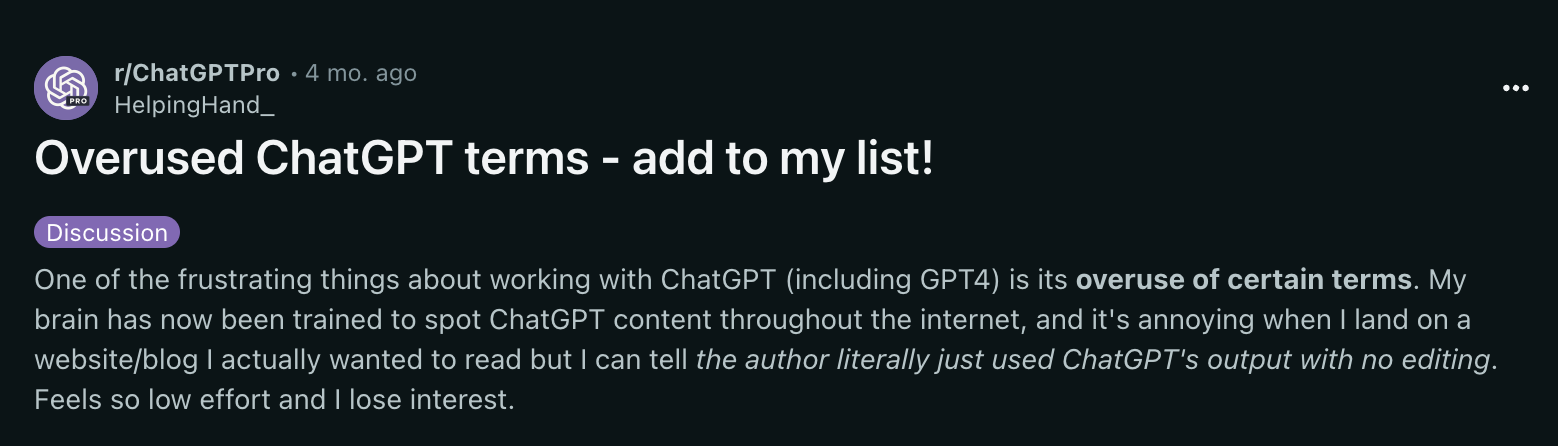
Eliminating repetitive phrases and words from your AI content can impact how AI-detecting tools see your content.
Identifying repetitive language can sometimes be difficult so I recommend reading out your content aloud. You'll be immediately able to tell when something doesn't read well.
To avoid this problem, eliminate as many repetitive keywords and phrases as possible and ensure you write in a more natural tone.
You can write in a natural tone by:
Writing like you speak
When editing AI-generated text, make sure it sounds like you're having a conversation with your reader.
Use everyday language, including contractions such as "it's" rather than "it is." This will make your writing feel more approachable.
Avoid jargon and complex terms
Use plain language and familiar vocabulary to convey your message.
If you must use technical terms, ensure that you explain them clearly to readers who may not be familiar with the subject matter.
Use active voice
Writing in an active voice can make your sentences more direct and engaging.
You could also alter sentences that are in the passive voice to the active voice.
"I was in awe of the Eiffel Tower" can be rearranged to say, "The Eiffel Tower left me in awe."
By doing this, you have kept the main idea of your message and avoided likely detection algorithms that might be looking for certain patterns or word combinations.
Vary sentence length and structure
Mix short and long sentences to create a natural rhythm in your writing. This can make your content more enjoyable to read, help maintain the reader's interest, and avoid detection by AI checkers.
This is one of the most effective techniques because it directly increases your burstiness score. Human writing naturally alternates between short, punchy sentences and longer, more complex ones. AI text tends to keep everything at a uniform length — and detectors pick up on that uniformity instantly.
Ask questions
Posing questions throughout your content encourages readers to reflect on the topic and engage with your writing.
Your writing will appear more natural because asking questions is normal in everyday speech.
5. Share personal anecdotes and perspectives
Using real-life examples, stories, or analogies can help readers understand your message and make your content more engaging.
Sharing personal anecdotes and first-hand experiences in your content can add a special touch that AI often struggles to replicate.
For brands and content creators, building trust and credibility with their audience is crucial.
Readers prefer content that they can trust, written by real people with expertise or experience.
If your audience suspects that your content is AI-generated, it might impact their trust in your brand or the authority of your content.
This doesn't mean that you have to write all your content by yourself.
Think of it as before the Industrial Revolution, when most goods were hand-made. The introduction of machinery automated most of the work, but the best goods still required careful intervention by humans.
Using only AI-written content may sometimes lead to a more robotic feel to your final article.
The robotic-sounding nature of using only AI-generated content may bore your end user in addition to getting your work flagged by an AI checker.
Instead of choosing between human and AI content, it's always a good idea to blend them both by adding some content that you wrote yourself to break up any possibility of AI content detection.
One of your main goals should be to provide helpful advice to your audience.
Adding human-written content to your project makes detecting computer-generated content harder for AI recognition tools.
6. Use descriptive prompts
It's important to remember not just to ask an AI generator to create content and then call it a day.
To improve the quality of your AI content, you need to write more descriptive prompts that can bypass search engine detectors. The more specific your prompt, the less predictable the output — which means higher perplexity scores and a harder time for detectors.
Writing a descriptive prompt is more likely to produce emotional and sentimental text with a conversational tone to it.
For example, you may end up with bland, low-quality content by using a prompt such as:
"Write a story about a forest."
You'll receive higher-quality text by being more descriptive.
"Describe a serene and peaceful forest, focusing on the sights, sounds, and smells that surround you as you walk through it in the early morning."
To help you write better descriptive prompts, take the basic idea of your original prompt and then ask the AI to describe the situation using different senses.
For example, a prompt like this:
"Write a story about a day at the beach."
It can be written descriptively by imagining what the situation would look, sound, and feel like:
"Craft a scene in which a character experiences the exhilaration and freedom of a coastal beach during a warm summer day, emphasizing the sensations of sand, surf, and sun on their skin."
Alternatively, you can produce high-quality AI content by using the "in the style of" technique. You can do this by adding this simple phrase to your base prompt.
For example, instead of using a prompt like:
"Write an ad for AI software."
You can add a style of tone or creative person you want to emulate to the prompt:
"Write an ad for AI software in the style of Quentin Tarantino."
With a prompt like this, you'll end up with content that should easily pass by any AI detection tool:
"In a world where every mundane task feels like a never-ending grind, one revolutionary piece of software dares to challenge the status quo. Prepare yourself for an adrenaline-pumping, mind-blowing, no-holds-barred adventure into the future of artificial intelligence."
Just make sure to choose a tone or style that works for the product you're selling, and let the AI do the rest.
You can use Surfer's AI editing assistant, Surfy, to edit parts of your content with better prompts.
Here's an example of content under a subheader titled "Brainstorming Techniques."
I want the advice to be more personable and in a conversational tone.
In my prompt, I asked Surfy to adopt such a tone and to speak on behalf of a professional screenplay writer.
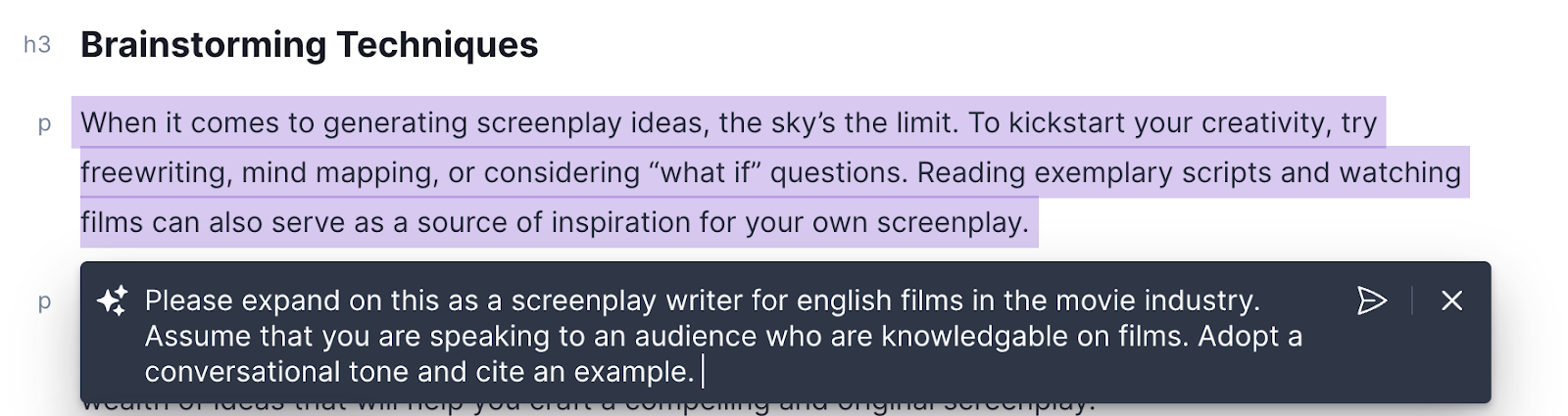
Here's a snapshot of the content Surfy generated for me.

As you can see, the content reads better and is more effective at communicating my point.
There is no way to tell that a human did not write the content.
7. Use paraphrasing tools (with caveats)
If you're dealing with AI-written content that feels too robotic or spammy, you can also use a paraphrasing tool to help you effectively replicate human writing styles.
Using paraphrasing tools can help you create content faster while passing AI-checking software. They can improve the tone of your AI content and work well alongside other detection-avoidance techniques.
A word of caution: research shows that paraphrasing alone doesn't change the underlying statistical patterns that detectors measure. Turnitin now detects paraphrased AI text. Treat paraphrasing as one step in a larger workflow, not a standalone fix.
Here are 4 paraphrasing tools to consider.
Surfy
Surfy is Surfer AI's built-in editing assistant and can help rephrase your sentences or entire paragraphs easily.
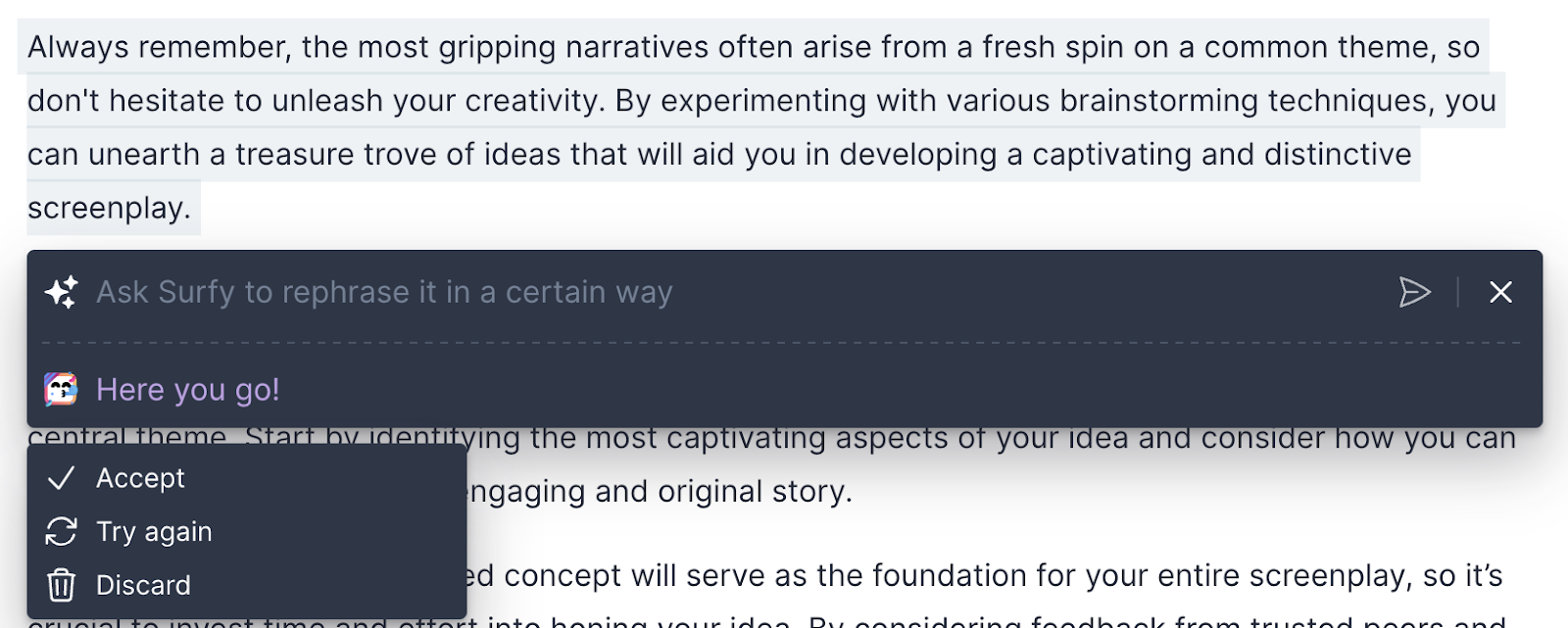
Select the paragraph or sentence you want to edit and click the Rephrase option.
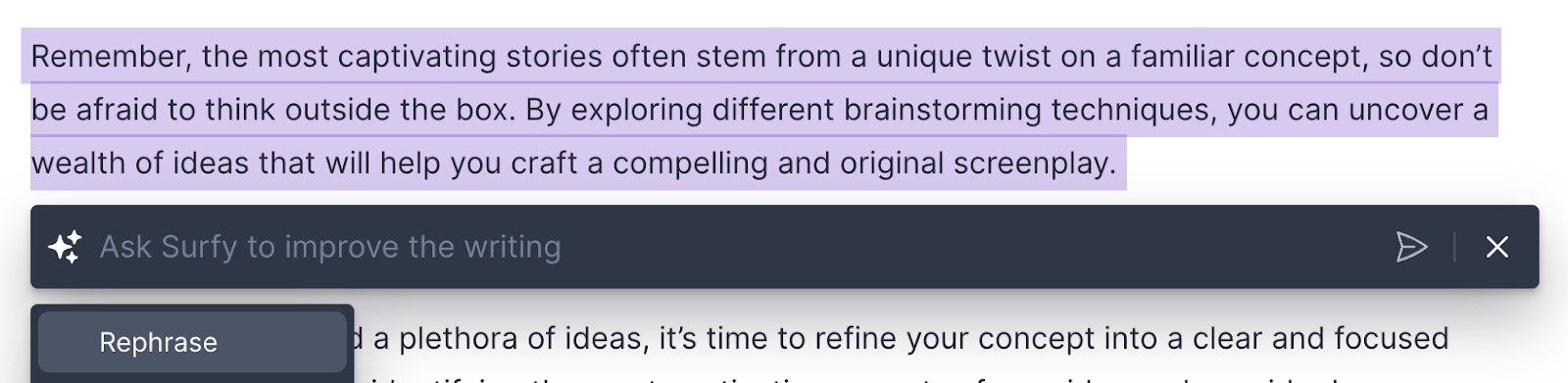
Of course, you can also type a more detailed prompt if you want specific paraphrasing of your content.
You can then accept the newly written content or start over.
Grammarly
Beyond its grammar and spell-checking capabilities, Grammarly can serve as an effective paraphrasing aid. It helps you write with clarity and brevity while correcting punctuation, grammar, and detecting AI content issues.
Quilbot
Quilbot is a dedicated paraphrasing tool that uses AI to produce text that understands context, meaning, and human speech structure. It can rewrite large amounts of text quickly while producing unique content.
Wordtune
Wordtune uses context-aware AI to restructure your text into something more human-sounding. It gives you multiple rewriting options so you can choose the version that best matches your desired style and tone.
8. Use competent AI writing tools
As good as some free AI generators like ChatGPT are, these types of AI programs are easy for AI detectors to find.
One of the best ways to avoid AI detection is by using content-focused AI writing software designed to produce AI content that feels like a human writer.
Instead of just spinning content from other sites, these tools are designed to create content that offers value to readers.
Using a highly-rated AI writer for your articles means that you won't have to spend hours rephrasing or editing your AI content to pass AI detection.
Surfer AI, for example, is an AI writing tool that allows you to write complete articles that are optimized for search engines while bypassing AI content detectors.
Surfer's AI tool generates high-quality content capable of surpassing AI detectors by allowing you to choose your tone of voice and organic competitors, so you don't end up with a wall of text that reads like a robot wrote it.
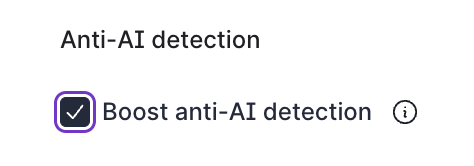
Just toggle on the anti-AI detection switch to create content that will be recognized as if written by a human writer.
Review the AI-written outline for your article and let Surfer AI write a complete article for you in a couple of minutes.
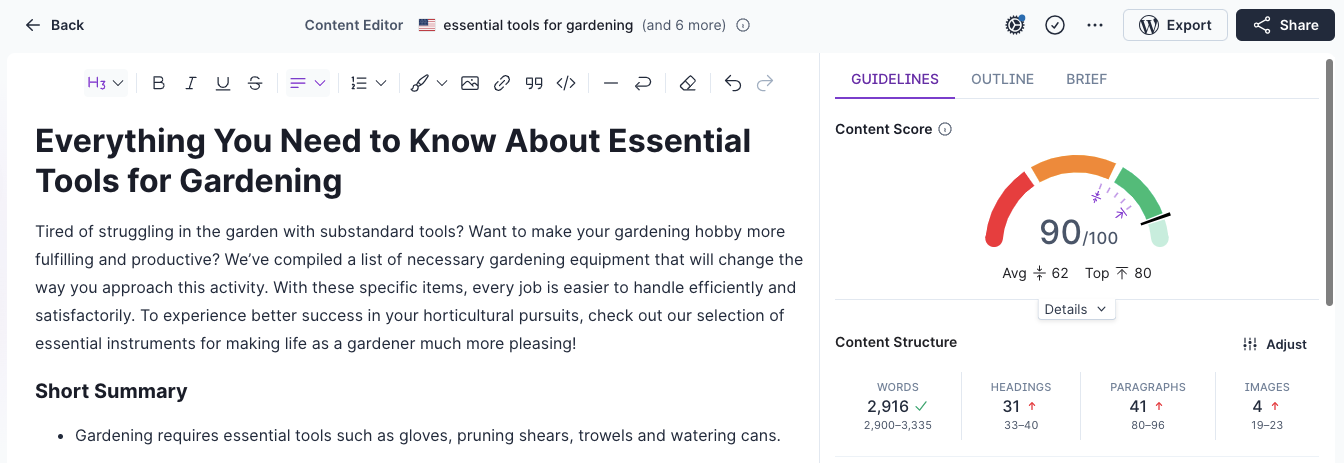
Here's an example of two articles on the same topic, "essential tools for gardening" written by Surfer AI.
We'll enable the anti-AI detector for one of the articles to demonstrate its efficacy and compare it to an article written without using the anti-AI boost.
We didn't use the anti-AI detection option to create the first article.
It's a well written article that covers the topic well and will rank well on search engines.
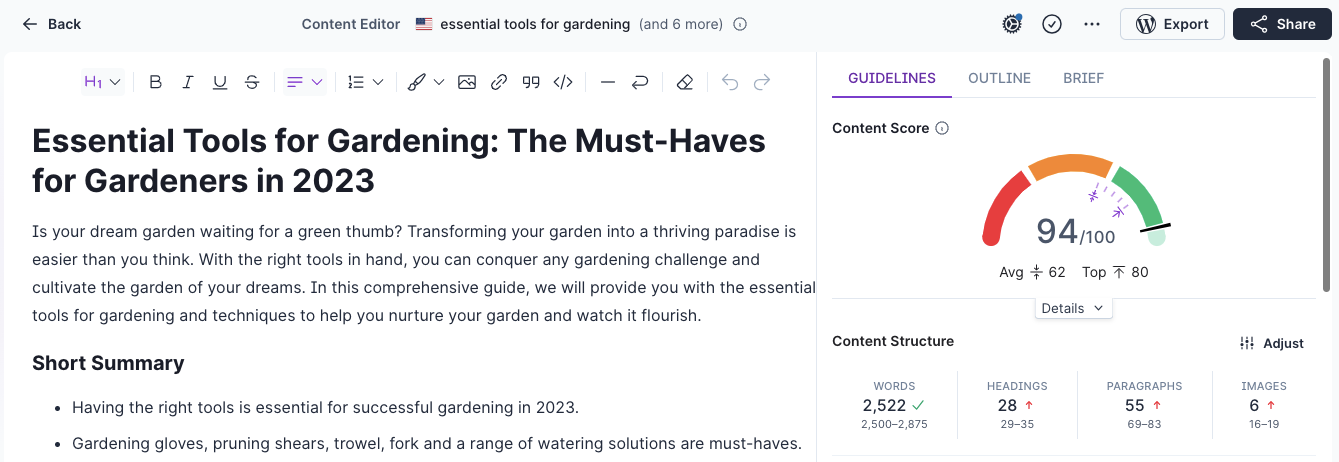
But the content may not pass an AI text detector if you're really strict about AI content.
In the second article, we switched on the anti-AI feature and generated a new piece of content.
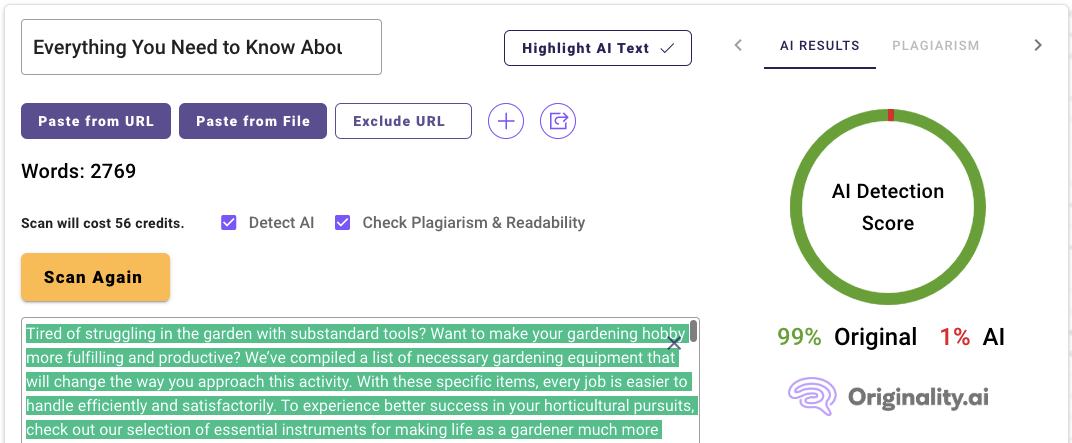
We then used Originality.AI, one of the most popular AI content detection platforms, to detect AI content in our article.
Doing so resulted in an article that was identified as 99% human-written and only 1% AI-created!
Not only will you receive high-quality content that can surpass Google's detectors with Surfer AI, but you'll also be able to do this with minimal prompts, with the final result being SEO-ready.
Other AI generators don't create content specifically for search engine algorithms.
9. Use human editors and moderators
Having human editors review the content generated by AI tools can help identify areas that need improvement and ensure that the content is easy to understand and engaging for human readers.
When reviewing AI-generated content, instruct your editors to look out for repetitive or formulaic language, unnatural sentences, and any apparent signs that AI tools generated the content.
Ensuring that all claims made in the content are accurate is especially important. While you can get away with bad grammar with a slap on the wrist, making false claims will land you in content jail.
I recommend establishing a simple editorial review checklist for AI-generated content:
- Verify all facts, statistics, and claims — AI models frequently hallucinate data
- Check for AI tell-words (delve, leverage, moreover, etc.) and replace them
- Read the content aloud to check for natural flow and conversational tone
- Ensure the piece includes personal insights or perspectives that only a human could provide
10. Focus on structural rewrites, not surface swaps
This is one of the most important distinctions to understand if you want to avoid AI detection effectively: there's a massive difference between surface-level edits and structural rewrites.
Research from AI detection studies shows that different levels of editing produce very different results against detectors. Here's how it breaks down:
Surface swaps (high detection risk): Replacing individual words with synonyms, using a thesaurus on AI text, or running content through a basic spinner. These changes don't alter the underlying statistical patterns — the sentence structure, rhythm, and predictability remain the same. Detectors see right through them.
Structural rewrites (moderate detection risk): Reorganizing paragraph structures, combining and splitting sentences, changing the order of ideas, and varying sentence lengths. These changes disrupt burstiness and perplexity patterns more effectively because they alter how the text flows.
Human-edited rewrites (lowest detection risk): Adding original insights, personal anecdotes, unique examples, and expert analysis on top of structural changes. This produces content that is genuinely different from AI output because it contains information and perspectives the model never generated.
The takeaway is clear: if you're only swapping words, you're wasting your time. Real detection avoidance requires changing how the content is structured, not just which words it uses.
When I edit AI-generated content, I follow a three-step approach: first, restructure paragraphs and vary sentence lengths (structural rewrite). Second, replace AI tell-words with natural language (targeted surface edits). Third, inject my own experience and examples (human-edited layer). This layered approach addresses all three detection vectors — burstiness, perplexity, and pattern recognition — simultaneously.
Your complete AI content workflow
One advantage Surfer offers over standalone tools is a complete end-to-end workflow for producing AI-assisted content that reads as human-written. Instead of cobbling together separate tools, you can handle the entire pipeline in one place.
Here's the five-step workflow I recommend:
- Draft with Surfer AI Writer: Start by generating your article with Surfer AI. Toggle on the anti-AI detection switch to produce content that's optimized for both search engines and detection avoidance from the start.
- Humanize with Surfer Humanizer: Run your draft through Surfer's AI Humanizer to further reduce AI detection signals. The tool will adjust phrasing, vary sentence structures, and replace predictable patterns.
- Optimize with Content Editor: Use Surfer's Content Editor to ensure your article hits the right SEO targets — keyword coverage, content structure, and topical depth. This step ensures your content ranks, not just passes detection.
- Verify with Surfer AI Detector: Before publishing, run your final draft through Surfer's AI Detector to confirm it reads as human-written. If any sections still score high for AI, go back and apply the manual editing techniques from this guide.
- Monitor with Content Audit: After publishing, use Surfer's Content Audit to track how your AI-assisted content performs over time. If detection tools update their models (as Turnitin did in August 2025), you'll know which pages may need re-humanization.
No competitor offers this kind of integrated pipeline. Most tools handle only one step — detection, humanization, or writing. Surfer covers all five, which means fewer tools, less context-switching, and a more consistent output.
Can Google detect AI content?
It isn't perfectly clear, but it is very likely that yes, Google can identify AI-generated text using natural language processing (NLP) and machine learning algorithms.
The search engine giant has vast access to data and is developing its own AI tools, so it almost certainly has the capability to pinpoint AI-generated text.
Google's February 2026 core update made the stakes clearer than ever. Sites mass-producing AI content saw 40–60% traffic drops, while hybrid human-AI content continued performing well. The update specifically targeted thin, unedited AI content produced at scale — not thoughtfully created AI-assisted articles.
There's an important distinction in Google's spam policies that many content creators miss: Google differentiates between "AI content created for users" and "AI content created for ranking manipulation." The first is perfectly fine. The second gets penalized.
Ultimately, Google's search guidelines state that their main goal is to reward original, high-quality content however it is produced.
Here's a snippet from their documentation on AI content.

Google's goal is to reward quality content that is helpful for people, not just search engines.
So AI-generated content is perfectly fine as long as it's written with people in mind first — and as long as you're adding genuine value rather than flooding the index with low-effort pages.
Using AI content responsibly
The question isn't whether to use AI for content creation — it's how to use it responsibly. In 2025 and 2026, the brands winning with AI content are the ones being transparent about it.
Research shows that consumers support brands using generative AI, as long as companies are transparent about it. The reputational risk isn't in using AI — it's in pretending you don't.
There's a critical distinction between two very different contexts:
Content marketing and publishing
For marketers, copywriters, and content teams, using AI as a productivity tool is increasingly standard practice. Companies like Shopify have publicly told employees that AI use is a baseline expectation. The Associated Press has used AI for automated reporting since 2014. In these contexts, the goal isn't to deceive — it's to produce better content faster, then refine it with human expertise.
Academic and professional integrity
For students, researchers, and professionals in regulated fields, the stakes are different. Submitting AI-generated work as your own in academic settings violates integrity policies at most institutions. Turnitin's August 2025 update specifically targets this scenario, and the consequences can be severe.
The line between responsible and irresponsible AI use comes down to intent. Are you using AI to create genuinely helpful content that you then refine with your own expertise? That's responsible use. Are you mass-producing low-quality content to manipulate search rankings? That's what gets penalized — by Google's algorithms, by your readers, and by your reputation.
Your end goal should always be providing value to readers. An AI text humanizer is a powerful tool when used to make your content sound better and more natural — not to mislead audiences about who wrote it.
When should you avoid using AI content?
Avoid using AI-generated content when you are writing for YMYL niches or need to demonstrate expertise stemming from personal experience in your profession.
One of the main considerations when using AI content is making sure that you remain compliant with Google's E-E-A-T guidelines.
E-E-A-T stands for experience, expertise, authority, and trustworthiness, and it's the set of guidelines that Google uses to determine the legitimacy and quality of the content it delivers to its users.
The health and finance genres are commonly considered YMYL (Your Money or Your Life) niches and should blend human oversight with AI content. Google's 2025 and 2026 core updates have specifically targeted YMYL sites publishing thin AI content, resulting in significant ranking drops for sites that didn't apply proper editorial review.
Here are a couple of instances when you should avoid relying on AI content.
Complexity and personalization
Health and finance are highly complex fields that often require personalized advice based on individual preferences and risk tolerance. AI algorithms are unlikely to be sophisticated enough to consider all these factors and provide tailored recommendations.
Liability and accountability
In cases where AI-generated advice leads to negative outcomes, assigning liability and accountability can be challenging.
Legally, it's difficult to determine if the AI, the developer, or the end user should be held responsible for any consequences resulting from the advice.
Inaccurate or outdated information
AI algorithms rely on data to make predictions and provide advice.
If the data is inaccurate, incomplete, or outdated, AI-generated advice may lead to a potentially dangerous outcome.
Ethical considerations
There are serious ethical concerns surrounding the use of AI in health and finance, such as potential biases in the algorithms or the impact of AI-generated advice on job displacement for human professionals in these fields.
To remain compliant with Google's E-E-A-T guidelines, you should review and edit any content generated using AI content tools. Using an AI content humanizer can help you remove AI detected content.
Key takeaways
- AI detectors measure perplexity (word predictability) and burstiness (sentence-length variation) — understanding these metrics is the foundation of avoiding AI detection.
- Combine AI-generated and human-written text to improve the content's quality and make it more challenging for AI detectors to spot AI usage.
- Spot and replace overused AI tell-words like "delve," "leverage," and "moreover" — these lower perplexity and trigger detection flags.
- Using descriptive prompts when crafting AI content will produce higher-quality, less predictable text that scores better against detectors.
- Paraphrasing tools are helpful but not sufficient alone — combine them with structural edits for the best results.
- Focus on structural rewrites over surface-level word swaps. Changing how content flows matters more than changing individual words.
- Follow a complete workflow: draft with AI, humanize, optimize, verify with a detector, and monitor performance over time.
Better writing is the best way to avoid AI detection
As search engines continue to evolve and refine their algorithms, their ability to detect AI-generated content will become increasingly more sophisticated. Google's February 2026 core update proved that — sites relying on unedited AI content at scale saw dramatic traffic declines.
But the core principle hasn't changed: search engines prioritize providing users with high-quality, relevant, and valuable information. They're not concerned with how content is written — they care about whether it helps the reader.
The key to success isn't gaming detectors. It's striking a balance between AI efficiency and human expertise. By understanding how detectors work, applying the techniques in this guide, and following a structured workflow from draft to publish, you can harness the power of AI while delivering content that genuinely resonates with your audience.
The future belongs to human-AI collaboration, not detection evasion.