
I have lost count of nights with a blinking cursor and a blank page. I want a strong article, but ambition without a first move is a trap.
A good idea in my head is not the same as words on the screen. Until I force the concept into sentences, it stays fragile and easy to abandon.
When I build a piece that holds up, it feels less like one magic streak and more like a puzzle. Tone, structure, examples, and edits are smaller pieces that have to lock together.
My voice, the style I pick, and how much I lean on stories are not nice to haves. They carry the work. Keep reading for how we break writing an article into steps you can repeat.
Types of Articles You Can Write
Answer this first: what type of article are you writing? The format is not cosmetic. It sets headline tightness, how fast you owe a payoff, and how much proof each section needs. Name the type before you outline so the plan gets real constraints, not vague ambition.
Here is a quick map of common shapes. Pick one and steer the outline so the reader sees the promise up front.
Formats I rely on most:
- How-to articles: Step by step guidance for readers who need a clear order of operations. I use this when the open question is practical, not ideological, and I owe a path without guesswork.
- Listicles: Numbered or clustered items for skimming, stacking options, or quick comparison. Rankings and roundups fit when readers want choices fast and side by side thinking beats one long arc.
- News articles: Coverage of what changed, who it hits, and what may happen next while events unfold. I keep claims tight, ground them in checkable facts, and keep sources I can name on the record.
- Opinion and editorial articles: First-person pieces where the writer takes a stance on a topic. Strong arguments and supporting evidence are key.
- Feature articles: In-depth, long-form pieces that explore a topic from multiple angles. They often include interviews, storytelling, and detailed research.
- Interview articles: Articles built around a conversation with an expert or notable figure. The writer guides the narrative through questions and responses.
Each format also leans on different writing styles. A how-to guide is typically expository—clear and instructional. A feature piece might use narrative techniques to tell a story. Opinion pieces are persuasive by nature, while news articles aim for descriptive objectivity.
Understanding these distinctions helps you set the right expectations for your reader and choose the right structure before you start writing.
1. Choose a Topic and Know Your Audience
You can't bake a cake without ingredients, just like you can't write a good article without a topic to write about.
Ideally, your article will be on a topic in which you are a subject-level expert or, at the very least, very knowledgeable. This ensures you provide quality, informative content for your readers—and it's exactly what Google looks for.
Google evaluates content through a framework called E-E-A-T: Experience, Expertise, Authoritativeness, and Trustworthiness. In practice, this means writing about topics where you have genuine, firsthand experience. Search engines—and readers—reward content written by people who actually know what they're talking about.
For example, I'm no astronaut. Have I seen Interstellar a handful of times? Yes. But that doesn't make me qualified to talk about when we'll settle on Mars. Instead, I write about SEO because that's what I have experience in.
To showcase your expertise, add your credentials to your author byline. Stick to specific instances and situations where you have engaged with the topic!

But picking a topic you know isn't enough—you also need to confirm there's an audience for it. Before you start writing, ask yourself:
- Who is my target reader? What do they already know about this topic?
- What problems or questions are they trying to solve?
- Is there actual search demand for this topic?
You can validate topic demand using Surfer's Keyword Research tool. It shows you search volume, keyword difficulty, and related terms—so you're not writing into a void.
Understanding your audience early shapes everything that follows: your tone, your structure, your examples, and even which platform you publish on.
2. Select Your Publishing Platform
Before article writing, research potential platforms and choose one that aligns with your topic and audience.
You wouldn't post your article on the colonization of Mars on a racing forum.
Today's writers have more publishing options than ever. Beyond your own website, consider platforms like Medium, Substack, LinkedIn, Ghost, WordPress, and Beehiiv. Each has a different audience, editorial culture, and content style. Doing your research here pays off.
Once you've decided on a platform, analyze the tone and language used in that platform's articles. Take note of the writing style, readability and reading level, and the platform's audience and sophistication level.
Your article writing format will differ depending on your audience and desired publication.
Copy an article from your chosen platform into the Hemingway Editor or Surfer's Content Editor to check readability. These tools will show you the article's readability grade, helping you match the right level for your audience.
If the article is written well, aim for a similar reading score. However, a poor readability score does not always mean the article is constructed poorly—it could mean it uses more complicated jargon and technical terms.
For example, if we paste this NASA article into the Hemingway editor, it shows grade 15.
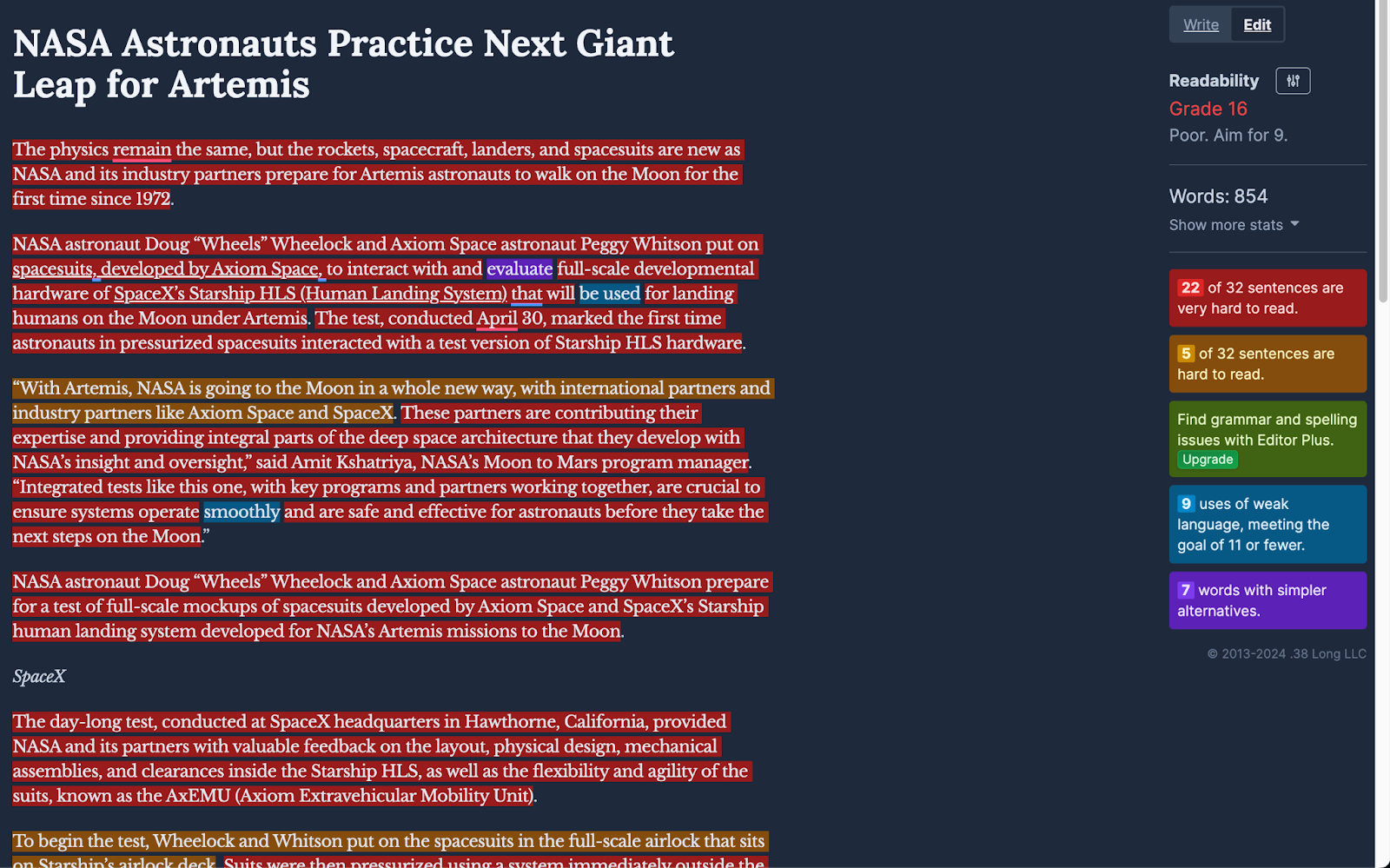
Let's compare this to an article published on Medium about the French Formula One racing driver, Esteban Ocon.
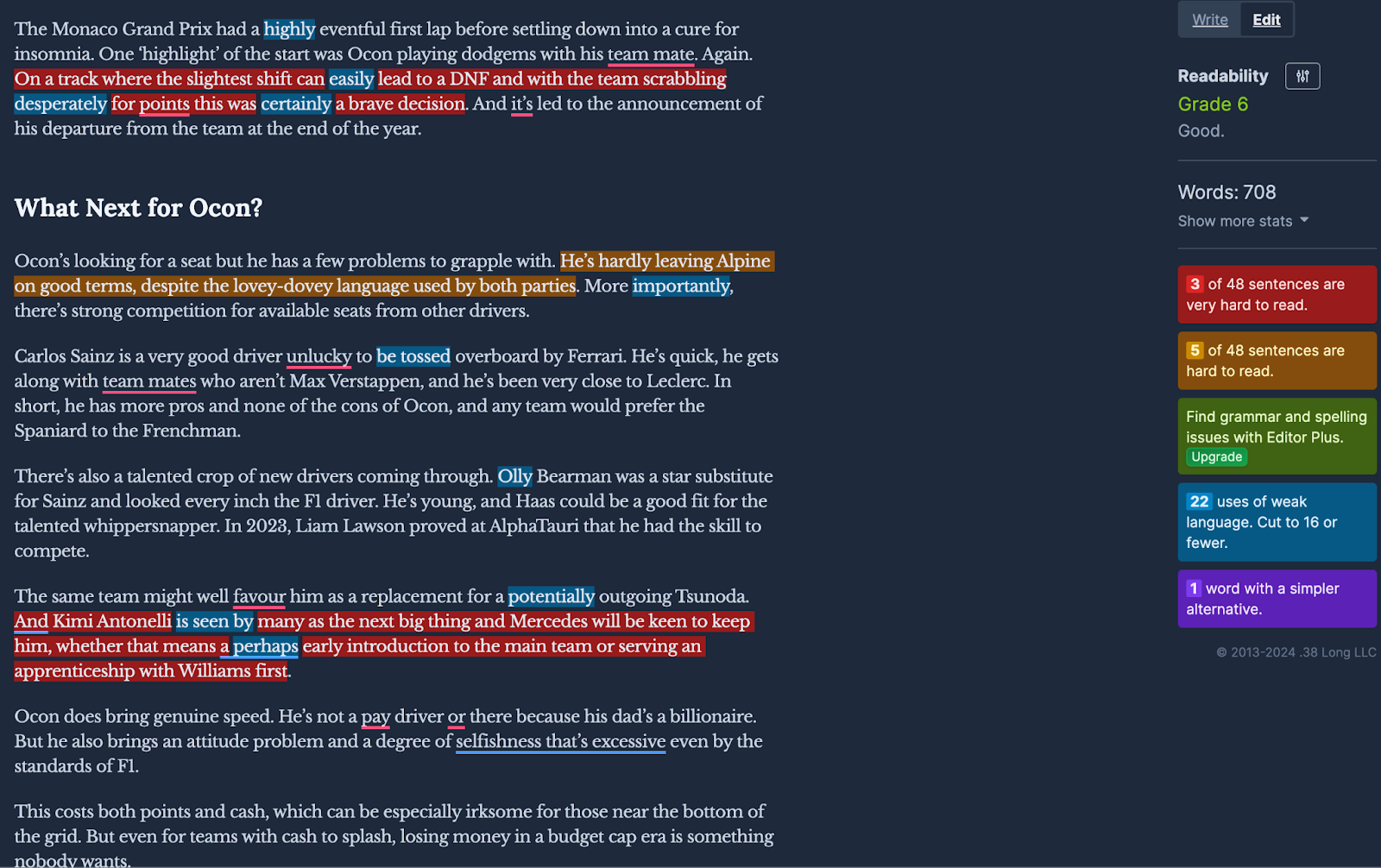
The Medium article gets a readability score of 6. It adopts less technical jargon and is a much lighter read.
Study Similar Articles
You might find it useful to read and study similar articles on the same topic before writing your own article. This will help you create a structure that is logical and easy to follow.
You can find similar articles by searching your topic on Google.
Stick to the top search results for the best articles—you don't want to accidentally inherit bad writing practices from other articles.
3. Research Your Topic
Good research is what separates a surface-level article from one that actually helps people. Every strong article is built on a foundation of solid research—and skipping this step is one of the most common mistakes new writers make.
Start by understanding what already exists. Search your topic on Google and study the top-ranking results. What do they cover? What's missing? What can you add from your own experience? This competitive analysis tells you what baseline your article needs to hit—and where you can stand out.
Surfer's SERP Analyzer makes this faster by breaking down the top-ranking pages for any keyword. You can see their word count, heading structure, keyword usage, and content gaps at a glance—without manually reading every competitor.
Next, gather your sources. Distinguish between primary sources (original research, interviews, your own data) and secondary sources (articles, reports, studies). Primary sources add unique value and boost your credibility. If you can interview an expert or cite your own results, do it.
When evaluating sources, ask yourself:
- Is this source credible and up to date?
- Does the data come from a reputable organization or study?
- Can I verify this claim with at least one other source?
Keep a running document of your sources, quotes, and data points as you research. You'll thank yourself when it comes time to write and cite your claims.
4. Brainstorm Ideas
Brainstorming techniques, such as mind mapping or free writing, are great ways to come up with ideas. It's a part of the writing process!
You can use this technique to help generate title ideas, the angle of your article, and the structure, i.e., what you will talk about and in what order.
You can use tools such as MindNode or Mind Meister to brainstorm. If you're feeling extra creative, putting pen to paper can help—I like to use A3 to visualize how the article will look.
AI tools have also become a powerful brainstorming partner. You can use ChatGPT, Claude, or Surfer AI to generate topic angles, sub-points, and even rough outlines in seconds. Feed the AI your main topic and ask for ten different angles—then pick the ones that resonate with your expertise and audience.
A brainstorm is a little like emptying a jigsaw puzzle and rearranging the pieces so they fit together.
When brainstorming:
- Eliminate repetitive, uninteresting, or unnecessary points
- Review your list and cross out ideas that add no value or are redundant
- Expand on points that stand out as particularly interesting or important
You can also use your brainstorming session to develop detailed sub-points or sub-headers for your main talking points—more on this below.
5. Create an Outline
Your article should flow naturally—the points and sub-heads should read in a logical order.
Create an outline that maps out the flow of your article from start to finish. You can do this in your brainstorming session or on a blank Google Doc.
You don't have to stick to the order once it's down on paper, but this exercise will help you visualize how your article will piece together.
It also makes sure your article is not mismatched—looking somewhat like a Mr Potato Head from Toy Story with his parts on wrong.
Surfer's Content Editor can help here by suggesting heading structures based on what's already ranking for your target keyword.
An excellent example of an article that structures its points logically is this guide on how to become a cybersecurity analyst by BrainStation.

Here's the outline of the article.
- H1: How to Become a Cybersecurity Analyst
- H2: 1. Learn Cybersecurity Fundamentals
- H3: Cybersecurity Fundamentals
- H2: 2. Practice Cybersecurity Technical Skills
- H2: 3. Earn a Cybersecurity Certificate
- H2: 4. Research the Cybersecurity Industry
- H2: 5. Apply to Cybersecurity Jobs
- H3: Cybersecurity Roles
- H2: What is a Cybersecurity Analyst?
- H2: Why Is Cybersecurity Important?
- H2: Cybersecurity Benefits
- H2: Is Cybersecurity a Growing Field?
- H4: 28%
- H2: What Is a Cybersecurity Analyst?
- H3: Cybersecurity Roles and Responsibilities
- H2: How Do I Become a Cybersecurity Analyst With No Experience?
As you can see, the outline makes great use of headings to explain how to become a Cybersecurity Analyst, breaking down each step in more detail.
Their content marketing strategy is to create in-depth guides that flow from one stage to the next.
To weave your ideas together, use transitional phrases—this will also improve the flow of your writing.
Example transitional phrases include:
- Furthermore
- Moreover
- Equally
- By comparison
- Yet
- For example
- In conclusion
Furthermore, replace phrases such as "however" with "but" and "therefore" with "so."
If there's a $1 alternative to a $2 word, use it.
This increases the readability of your article without it sounding too formal—unless you want it to be formal, of course!
6. Begin with a Strong Introduction
Research from the Nielsen Norman Group shows that users often leave web pages within 10 to 20 seconds unless the content gives them a clear reason to stay.
We live in a distracted world of constant notifications, TikToks, and Instagram reels. If your article fails to grab their attention immediately, there's a good chance they're going to click off your article to continue doom scrolling.
To combat this, show the reader they're in the right place by starting with a strong introduction and a relevant eye catching image. You'll also need an excellent hook.
How to Write a Good Hook
The hook is how you grab the reader's attention. Your first couple of lines should reel your target audience in, capturing their attention to continue reading.

But how do you do it?
To write a great hook, consider using:
- a proven copywriting formula
- a strong, impactful statement
- a compelling quote or question
- an anecdote or metaphor to draw readers in
7. Address Your Reader
Use simple and direct language that is easy to understand. This makes your writing more relatable and engaging because you're talking directly to your target audience.
Take it a step further by mentioning the reader's pain points in your article.
For example, if your article is about how to write an article—just like the post you're reading now—pain points may include:
- Not knowing how to come up with an idea for the article
- Not knowing where or how to publish the article
- Unsure how to adjust language and tone for your target audience
- Not knowing what SEO is or how to optimize it for your article
Address these pain points to keep readers engaged—you're answering their concerns and objections.
To find these pain points, try searching forum websites and online communities such as Reddit or Quora. Find a relevant subreddit and then use a custom Google search using phrases and modifiers such as "how to" and "what."
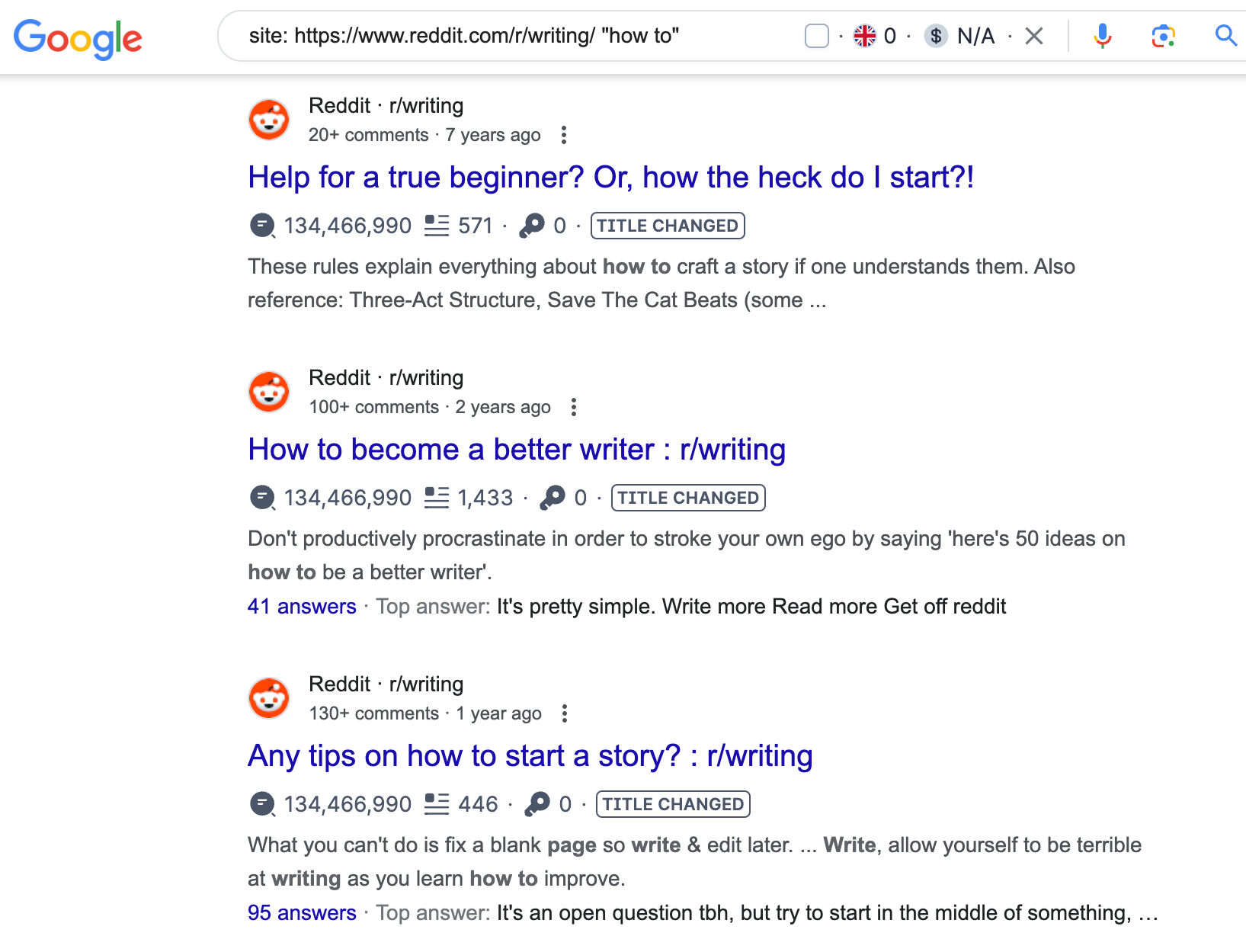
This trick will help you find relevant pain points.
It's a good idea to mention the primary pain point in the introduction of your article. This tells the reader they are in the right place.
8. Use Writing Formulas
Writing formulas are a writer's best friend. When used correctly, they help improve your messaging—you can talk directly to the reader and their problems.
Use proven copywriting formulas to help craft your introduction and other parts of your article.
Examples of proven copywriting formulas include:
- PAS (problem, agitate, solution)
- AIDA (attention, interest, desire, and action)
- SCQA (situation, complication, question, answer)
I find myself using the PAS formula the most in my work.
I use it when writing LinkedIn posts to hook the reader by relaying a specific problem to my audience.
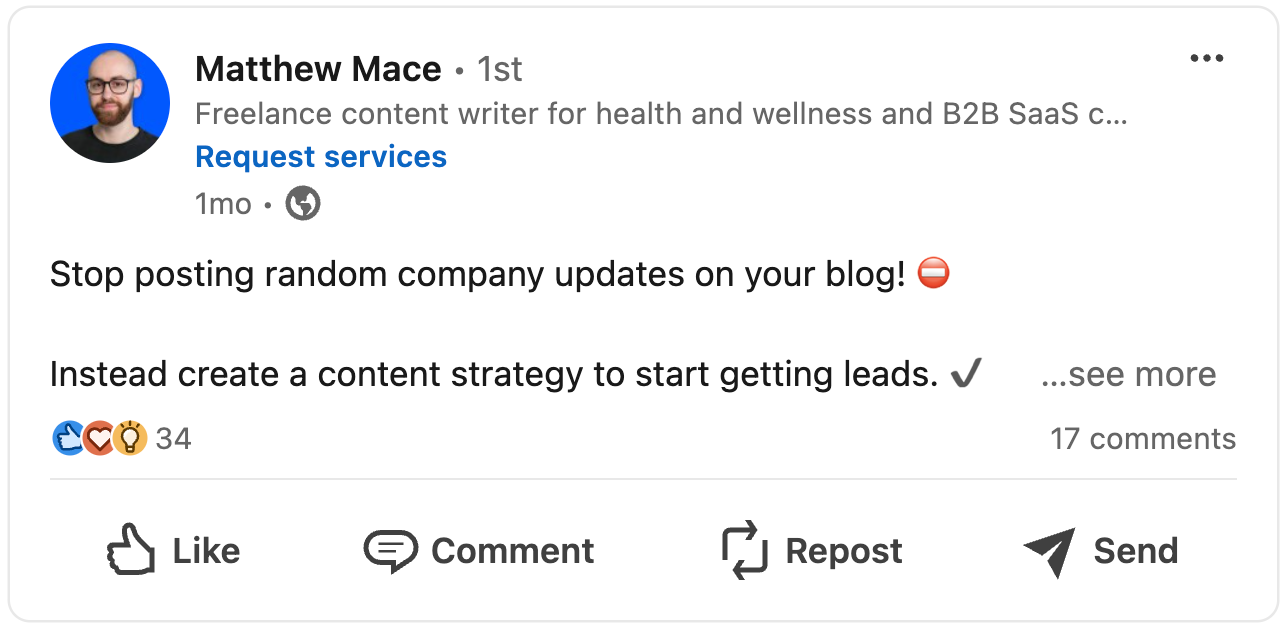
Furthermore, I often find myself using it to write an article introduction, showing the reader they are in the right place.
Adopting writing formulas can also help you get articles out faster on days you're not feeling creative.
PAS
The problem agitate solution is one of the more popular copywriting formulas. It's easy to use and is very effective.
- First, identify the problem your audience is having and make sure it is a problem that really affects them.
- Next, agitate the problem by highlighting pain points and consequences to make the issue feel urgent and pressing.
- Finally, provide your solution and show how it successfully solves the problem.
Using PAS in your writing can get people to connect with you and buy from you. For the PAS formula to be the most effective, it's important to do your research.

If you don't know what your audience's pain points are, then you'll struggle to talk to them directly. So do your research!
AIDA
Attention, interest, desire, action—AIDA for short.
- First, start by grabbing the reader's attention, whether a striking headline or controversial first sentence.
- Second, capture their interest by revealing more information—unique benefits and features, for example.
- Third, create a desire to continue reading; how will reading the article improve their life or solve their problem.
And finally, encourage the reader to take action, in this example, you want them to continue reading your article.
SCQA
Although not as popular as the above two formulas, the situation, complication, question, and answer copywriting formula is great for creating clear messaging.
- Begin by describing the reader's current situation.
- Second, introduce the complication that makes their situation worse.
- Third, pose a question about their situation—what would happen if the situation was resolved?
- And finally, provide your answer, whether a call to action or to continue reading your article.
9. Lean into Stories and Anecdotes
People love to hear from other people. It's human nature.
We love stories.
Lean into personal stories and anecdotes to make your article more interesting and relatable. It also makes for engaging articles.
Paint a picture for the reader—when and where did the event take place, what was the weather like, how did you feel?
Use descriptive language and help the reader step into your shoes, experiencing the story for the first time as if they were there.
A great example of this is an article titled, "Surfing the American Dream."
The article's introduction dives into the specifics, from how the author held their board to the temperature and the abysmal surfing conditions.

And while you might not be able to use personal stories and anecdotes for all articles, use them where possible.
Again, people love hearing from other people. So make the most of it and share your personal experiences—this is where writing on a topic you're familiar with comes in useful.
10. Pick an Angle
There's an old quote from the American General, Douglas MacArthur, that says, "Rules are meant to be broken."
And while he wasn't talking about writing, breaking the odd rule or two can help improve your writing.
Typically, most writers read existing content on the same topic and adopt the same or a very similar writing angle.
By changing the angle, you can offer a fresh perspective and a unique take that differs from the common viewpoint.
Take a look at this article by The Atlantic. The title and hook take a new spin on the tennis player, adding a personal perspective that goes against the common viewpoint.

If you want to grab the reader's attention—and you do—find ways to add a new spin to your article.
Use personal stories and anecdotes, as previously discussed, and go against the common viewpoint.
11. Write a First Draft
The first draft is where your article starts to take shape. The goal here isn't perfection—it's getting your ideas out of your head and onto the page.
John Swartzwelder, known for his comedy writing on the Simpsons, summarizes this perfectly in an interview in The New Yorker.
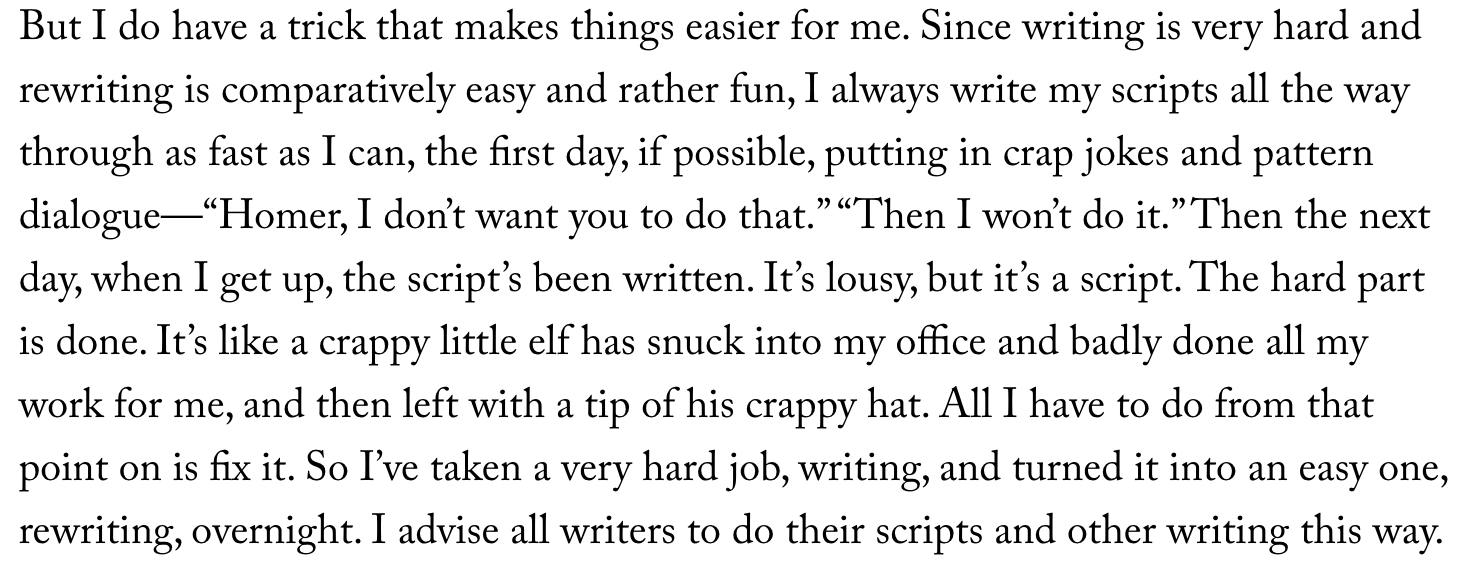
Although Swartzwelder is talking about scriptwriting, a lot of the same rules apply.
Today, AI tools can significantly speed up this step. Surfer AI can generate an outline and a full first draft in minutes—not hours. Enter your main topic, select a tone of voice, and you'll have a working draft to build on almost immediately.
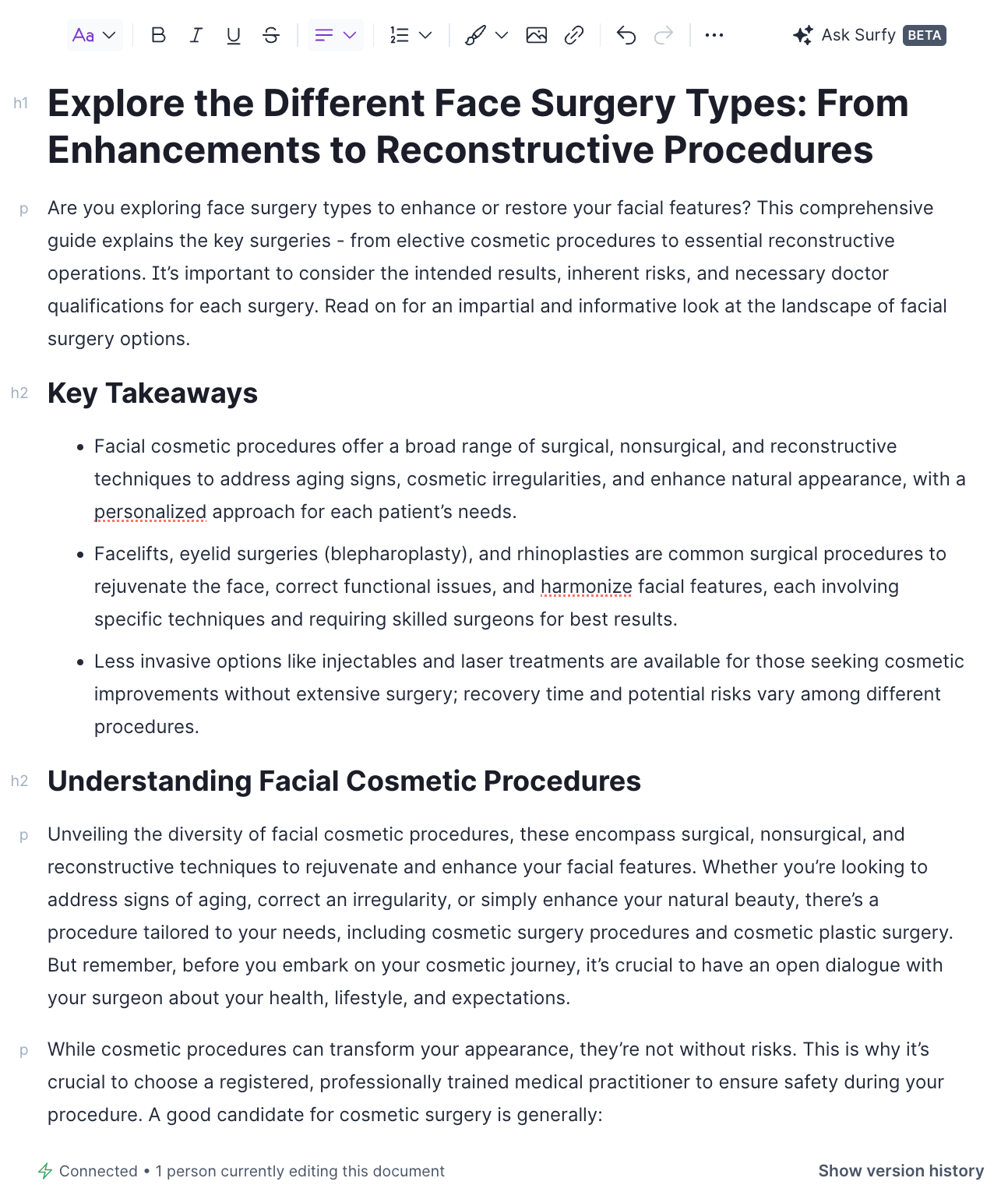
But here's the thing—AI accelerates the draft, but your expertise is what makes it good. An AI-generated draft is a starting point, not a finished article. You still need to:
- Add your personal experience, examples, and unique perspective
- Fact-check every claim and statistic
- Rewrite sections that sound generic or lack depth
- Adjust the tone to match your voice and your audience
Whether you write manually or use AI to get started, the same principle applies: focus on getting your ideas down without worrying too much about perfection. It's called a first draft for a reason—make the most of it!
12. Adjust Language and Tone
There is no one perfect writing language or tone. Your choice of language and tone of your article depends on your audience.
Going back to our NASA example—the language and tone are very different to say, an article on how to ride a bike.
The audience is completely different—one is likely a space enthusiast, while the other is looking for simple instructions to most likely teach a kid to ride a bike.
If you adopt a more informal approach, i.e., you're not writing about space or an academic piece, a good piece of advice is to write as if you were having a conversation with the reader.
Quality content doesn't have to be formal.
Use casual and informal language and avoid overly complex words when easier to read alternatives are available.
To nail the language and tone of your article, visualize your reader.
- How old are they?
- What do they look like?
- What hobbies and interests do they have?
- What pain points do they experience?
Give them an identity to take it a step further.
Throughout your article, sprinkle in idiomatic expressions—that's sayings such as "bite the bullet" or "feeling under the weather."
They don't take on the literal meaning of the phrase, but help make your article more lively. You can also use colloquial language and phrases—such as "hit the road" or "that was a piece of cake."
If your article is more factual than personal, you can adopt a more neutral tone by showcasing facts and figures and avoiding personal opinions and arguments.
Instead, provide all the information for the reader to form their own opinions and judgements.
The below example is an article of current events on Tesla from Emerging Tech Brew—it's factual and neutral throughout.

13. Take a Break Before Editing
Do as Swartzwelder says and take a break between your first draft and editing.
This is one of the most overlooked approaches when it comes to writing. All too often, people want to write and edit in one sitting.
Although leaving your first draft for a day—or at the very least a few hours—helps you gain a fresh perspective.
When ready, return to the article. You'll find it much easier to spot mistakes and identify any unclear or weak sections that require improvement.
Personally, I like to read my first and final draft on my iPad in a different room from where I write. The change in screen and setting help me find mistakes easily.
I take notes and highlight text I want to change before doing a final deep dive edit.
Edits I often make include making my main argument clearer and consistent throughout, using fewer words to get my point across, and adding bullet points to break down a particular topic or key points.
Keeping paragraphs short is also key to keeping the reader engaged.
14. Edit and Revise Your Draft
Your first draft and your finished article are very different. Your first draft is an opportunity to get down your ideas.
Nothing more!
Once that's complete, revisit your draft and start rewriting. Editing is what differentiates a professional writer from a casual one.
It's much easier to rewrite your first draft than it is to write and edit at the same time.
Once you accept this, your writing will likely improve, and you'll be better and faster at it.
Tools like Grammarly can catch grammar and spelling issues, while Surfer's Content Editor helps you optimize your content score as you revise. Use these alongside your own editorial eye—not as replacements for it.
So, when revisiting your draft, what should you look for? What should you improve?
Transform mediocre sentences
Edit and rewrite mediocre sentences into engaging and descriptive prose.
Improve readability
Rewriting your draft is an excellent opportunity to improve the overall readability of your article.
Replace $2 words with $1 alternatives.
Furthermore, use varied sentence structure and vivid language to make your article easy to read and engaging.
If your article is more academic, use high-level vocabulary or relevant vernacular where needed.
Show; don't tell
When article writing, add descriptive details to engage the reader—show, don't tell. Use sensory details and emotive language to help the reader experience your story first-hand.
Use images to support your writing, especially if you're creating a how to article or walkthrough guide.
An example of telling:
"It was hot outside."
An example of showing:
"When he stepped outside, beads of sweat trickled down his face. The heat hit his face like the final knockdown blow of a ten-round fight."
Moreover, if you are writing a more academic or formal piece, you can show by adding visuals, charts, screenshots, and relevant examples.
Use the rule of three
The great Julius Caesar may have said, "I came, I saw, I conquered," but he also employed the persuasive language technique known as the rule of three.
Grouping three items together is more memorable and persuasive than one or two ideas.
Use the rule of three to engage the reader.
Always support your claims
Always perform research and include supporting evidence from reliable sources where necessary. This adds credibility to your article.
This way, if a reader wants to dig deeper, they can check the studies.
Furthermore, you might choose to conduct interviews and add expert quotes from trusted sources, too.
Professional writers and journalists do this often to add further trust and credibility when article writing.
It's a little extra effort but it's very worthwhile.
Use vivid imagery
Vivid imagery that uses short paragraphs is an excellent way to capture your audience's attention, helping them stay engaged throughout the entire article.
For an illustrative example of vivid imagery, check out the text below from an article on Pompeii for Hyperallergic.

The writing creates a clear picture of the events, and helps the target audience understand how the events unfolded.
15. Write a Strong Conclusion
A strong conclusion is just as important as a strong introduction. It's your final chance to leave an impression on the reader and drive them toward a specific action.
Don't just summarize—reinforce. Briefly revisit your main argument or the key takeaway, but frame it in a way that feels forward-looking rather than repetitive.
Here's a simple structure that works for most articles:
- Restate the core insight: Remind the reader what they came here to learn and confirm you've delivered on that promise.
- Add a final thought: Share a personal reflection, a bold statement, or a future implication that gives the reader something to think about.
- Include a call to action: Tell the reader exactly what to do next—try a tool, leave a comment, share the article, or apply what they've learned.
Avoid introducing new information in the conclusion. This isn't the place for new arguments or data points. It's the place to tie everything together and send the reader off with clarity and purpose.
A weak conclusion can undermine an otherwise excellent article. Give it the attention it deserves.
16. Come up with a Compelling Title
Similar to writing a first draft, I always write a draft title.
You likely wouldn't marry the first person you dated, either.
Generate a few draft title ideas and choose your favorite one.
To write a compelling title:
- Use intriguing language or play on words to make the title stand out
- Consider using rhetorical questions, references, or alliteration
- Make the title memorable and engaging, prompting curiosity
From an SEO perspective, your title also needs to work for search engines. Include your primary keyword naturally—ideally near the beginning. Consider adding power words (like "proven," "complete," or "step-by-step"), numbers, or brackets to improve click-through rates in search results.
It's very important that your title accurately reflects your article.
Yes, exaggerating your title may get more people's attention at first, but if you don't follow through, you'll quickly lose their trust.
Avoid misleading titles that do not represent the article's main points.
Here's an example of a compelling title that follows the above advice.

The article offers unique insights, and while it looks like hyperbole at first glance, it's not.
17. Optimize for SEO
SEO, or search engine optimization, is how you help your article reach the right audience through search engines. Without it, even the best-written article can go unread.
Here's how to approach SEO optimization step by step.
Align with search intent
Before writing a single word, understand what the searcher actually wants. Is the query informational, transactional, or navigational? Your article's format and depth should match the intent behind the keyword. Search your target keyword on Google and study what types of content rank—that's your blueprint.
Use semantic keywords
Modern SEO goes beyond stuffing a single keyword into your article. Search engines use natural language processing to understand topics holistically. Include related terms, synonyms, and semantically connected phrases throughout your content.
Surfer's Content Editor shows you exactly which keywords and phrases to include, how often, and where—taking the guesswork out of keyword optimization.
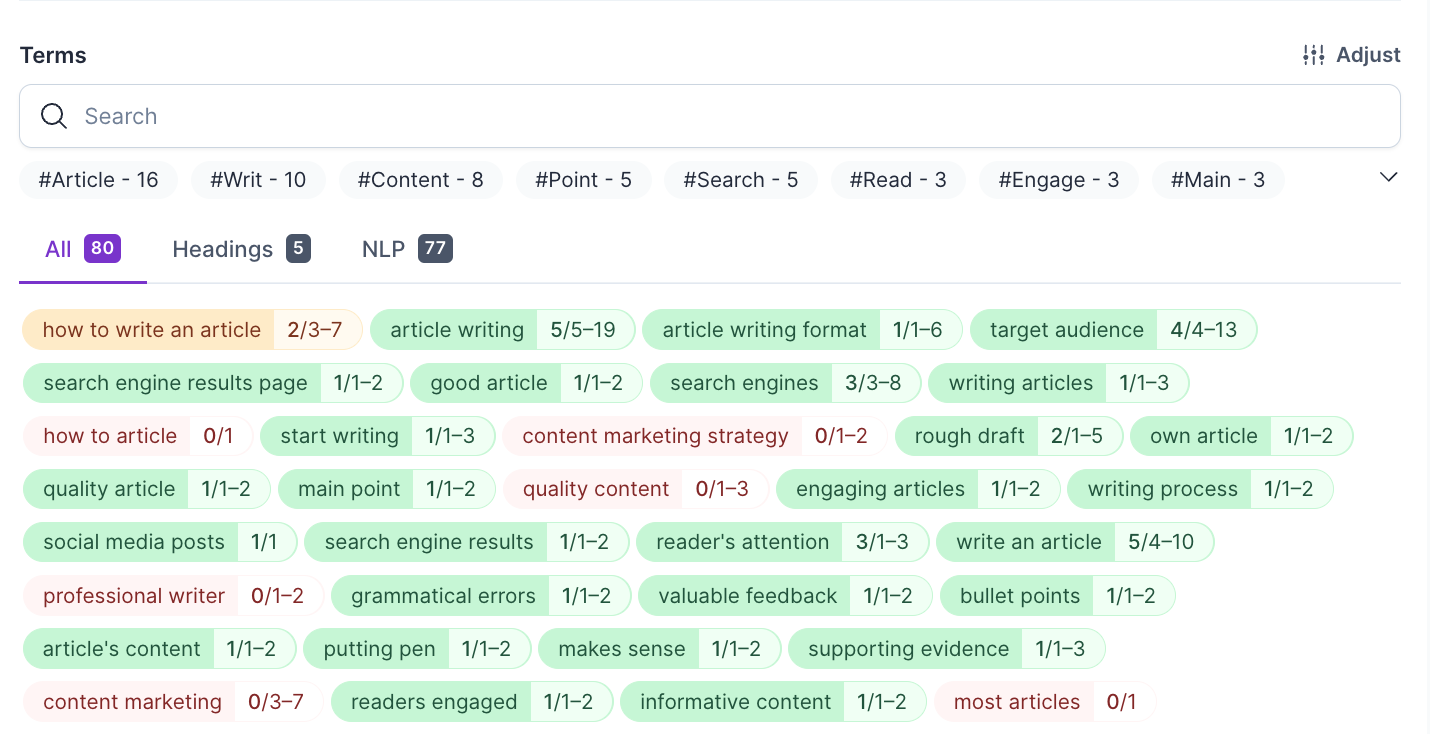
Knowing which keywords to include can save you time in research that you can put to other content marketing efforts.
Place keywords strategically
Once you have your primary keyword, include it in these key locations:
- Your URL
- Your meta title
- Your H1
- In paragraph tags (naturally throughout your article)
For example, this article from Investopedia on how to trade stocks uses their main keyword in all of the above recommended places.

This helps the article show up in search engines for relevant keywords.
Build internal links
Link to other relevant articles on your website. Internal links help search engines understand your site's structure and distribute authority across your pages. They also keep readers on your site longer.
Optimize for featured snippets
Featured snippets are the answer boxes that appear at the top of Google's search results. To increase your chances of winning one, structure your content with clear headings, concise definitions, numbered lists, and direct answers to common questions.
Check your content score
Use Surfer's Content Editor to check your content score against top-ranking competitors. The tool analyzes word count, keyword density, heading structure, and more—giving you a data-driven target to hit. Aim for a content score of 67 or higher for the best results.
Follow Google's quality guidelines
Google's Helpful Content system rewards content created primarily for people, not search engines. Ask yourself: does this article provide genuine value? Would a subject-matter expert consider it thorough and accurate? Combine this with strong E-E-A-T signals—author credentials, cited sources, and firsthand experience—and your article will be positioned to rank well and stay there.
18. Ask for Feedback and Publish
Receiving feedback on your article is a great way to not only improve that article, but also your overall writing.
If you're lucky enough to work with an editor, they will often highlight and comment on your document with suggested changes.
You may even have a style guide to refer to. But if you don't have an editor, you can ask a friend, family member, or colleague to read your article.
They can help catch errors, spelling mistakes and grammatical errors and ensure your article's content makes sense.
You can also submit your article to a writing group or someone proficient in the topic for valuable feedback.
When sending your article off for review, it can be helpful to send the submission guidelines—if you have any—to receive better and more accurate revisions.
Once you're confident in the final version, hit publish. Don't let perfectionism hold your article hostage—at some point, it's ready to meet its audience.
Key Takeaways
- Choose a topic you're knowledgeable about and confirm there's audience demand for it
- Pick a publishing platform that matches your audience and content style
- Research your topic thoroughly—study competitors, gather credible sources, and identify content gaps
- Use brainstorming and AI tools to generate ideas and structure your article
- Create a clear outline with logical heading structure and smooth transitions
- Capture attention with a strong introduction and a compelling hook
- Address your reader directly by speaking to their pain points in second person
- Use proven copywriting formulas like PAS, AIDA, and SCQA
- Lean into stories, anecdotes, and unique angles to differentiate your content
- Write a first draft—use AI to accelerate, then add your expertise and voice
- Adjust language and tone to match your audience
- Take a break before editing to gain fresh perspective
- Edit ruthlessly: show don't tell, support your claims, use vivid imagery
- Write a strong conclusion with a clear call to action
- Craft a compelling, keyword-optimized title
- Optimize for SEO with semantic keywords, internal links, and content scoring
- Ask for feedback, then publish with confidence
Ready to put these steps into practice? Try Surfer's Content Editor to optimize your next article for both readers and search engines—or use Surfer AI to generate a high-quality first draft in minutes.
Frequently Asked Questions
What are the 7 steps to writing an article?
A simplified article writing process includes: (1) choose a topic, (2) research it, (3) create an outline, (4) write a first draft, (5) edit and revise, (6) optimize for SEO, and (7) publish. This guide expands on these fundamentals with 18 detailed steps for a more thorough approach.
How do you start writing an article?
Start by choosing a topic you're knowledgeable about and confirming there's an audience for it. Then research your topic, study what's already ranking on Google, and create an outline before writing your first draft. A strong opening hook is essential to keep readers engaged from the first sentence.
How do you write an article for beginners?
If you're new to article writing, follow a step-by-step process: pick a topic, research it, outline your main points, write a rough first draft without worrying about perfection, then go back and edit. Use tools like Surfer's Content Editor for SEO guidance and Grammarly for grammar checks. The most important thing is to start writing—you'll improve with practice.
How long should an article be?
Article length depends on the topic, audience, and search intent. A short news piece might be 500–800 words, while an in-depth how-to guide can range from 1,500 to 3,500 words. Focus on covering the topic thoroughly rather than hitting an arbitrary word count. Use Surfer's Content Editor to benchmark against top-ranking competitors for your specific keyword.
Can I use AI to write an article?
Yes, AI tools like Surfer AI can help you brainstorm, outline, and generate first drafts quickly. However, AI works best as a starting point—not a replacement for human expertise. You still need to add your own experience, fact-check claims, adjust the tone, and ensure the content genuinely helps your reader.
What is the difference between an article and a blog post?
The terms are often used interchangeably, but traditionally an article is a more formal, researched piece published in a magazine, newspaper, or journal. A blog post tends to be more informal and conversational, published on a website or platform. In practice, the line has blurred—what matters most is that your content is well-researched, well-written, and serves your audience.


.avif)
